How to Buy Bitcoin for Beginners: Step-by-Step Guide

What Is Bitcoin?
Bitcoin is a digital currency that allows you to send and receive money over the internet without needing a bank to process the transaction. It was created in 2009 by an anonymous developer named Satoshi Nakamoto with a total fixed supply of 21 million coins to be issued slowly over time .
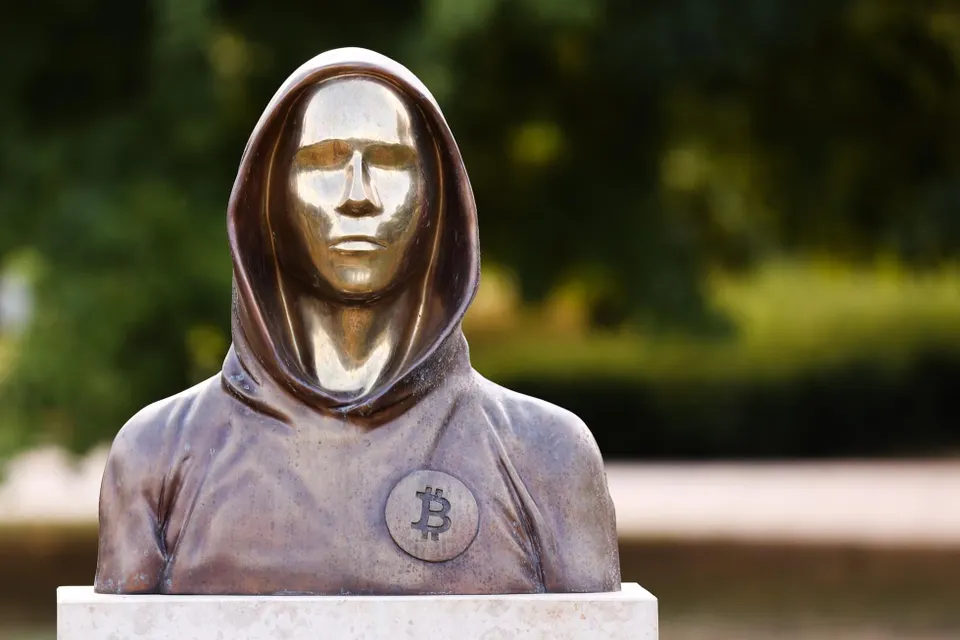
Bitcoin operates on a decentralized network, meaning no single company, bank, or government controls the Bitcoin network.
In general, there are 3 types of currency aka money that circulates within the global economy:
- Government Money (aka fiat money): United States Dollar (USD, Euro (EUR), Japanse Yen (JPY), etc
- God's Money: Gold and Silver
- People's Money: Bitcoin (BTC)
Government print fiat money and issue them every fiscal year to facilitate transactions for goods and services.
God created Gold and Silver as elements on earth for humans to use in exchange for goods and services.
Satoshi Nakamoto created Bitcoin to serve as the “people's currency” or “people's money”.
Bitcoin transactions are recorded on a public blockchain. Thousands of computers around the world help maintain and verify this network, which allows people to transfer bitcoin directly to one another.
You also don't need to buy one whole bitcoin. Bitcoin is divisible into 100 million smaller units called satoshis, or sats.
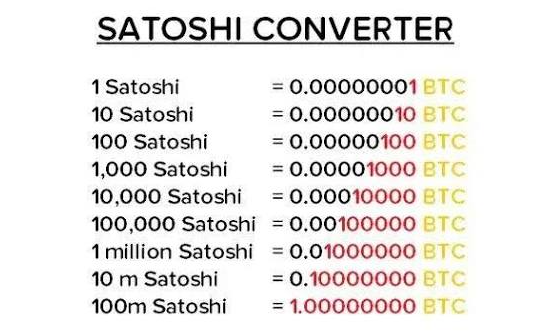
If one bitcoin costs $80,000, you could buy $10 worth, $100 worth, or any other amount supported by the service you're using.
For example, Robinhood provides default Bitcoin purchase amounts in the form of USD on its “Buy Bitcoin Page”.
Why Do People Buy Bitcoin?
I personally buy Bitcoin to build an emergency savings and stash away money for my retirement.
Here are several reasons why beginners buy Bitcoin for the first time:
- Some people view Bitcoin as a long-term investment.
- Others want an asset that isn't controlled by a central bank.
- Some use it to send money internationally, while
- Others simply want to learn how Bitcoin works by owning a small amount.
Bitcoin's price swings wildly throughout the day because it trades 24/7/365 just like fiat currencies. For example, BTC experienced its biggest weekly nominal gain ever in August 2026 after Donald Trump and the US Government agreed to buy back treasury bonds and push for the Clairty Act to be signed into law.
It can rise or fall significantly, sometimes within a short period. Buying Bitcoin therefore carries risk, and you should only invest money you're comfortable putting at risk.
The important thing to understand as a beginner is that buying Bitcoin is relatively simple; buying and storing it safely requires more thought.
This guide will walk you through the entire process—from choosing where to buy Bitcoin and making your first purchase to understanding fees, choosing a wallet, avoiding common mistakes, and deciding what to do with your bitcoin afterward.
I bought Bitcoin for the first time in 2019 so I have over 7 years of knowledge and experience to share with you in this article.
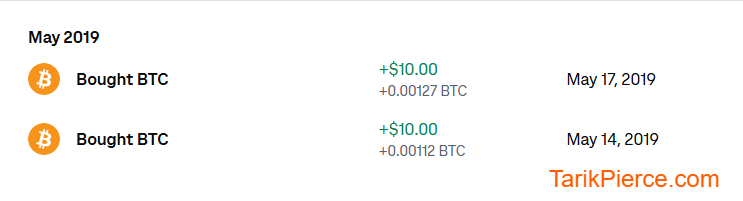
You don't need to buy an entire bitcoin to get started. My first Bitcoin purchase was for $10 via Coinbase when BTC was only $8,041 on May 14th 2019.
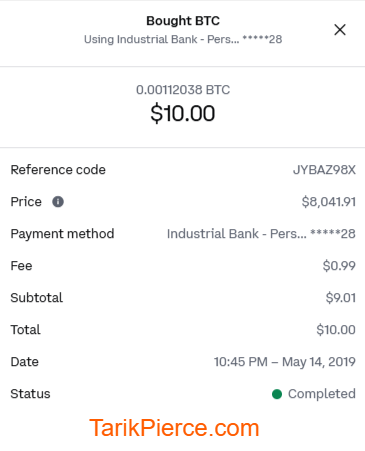
I'm now up almost 10x on my first initial Bitcoin investment around 7 years ago.
You also don't need to be some fancy cryptocurrency expert with a massive social media following.
The goal is to understand what you're buying and make your first purchase with a clear understanding of how the process works.
How to Buy Bitcoin: Step by Step
The basic process is:
- Choose where to buy
- Create an account
- Deposit money
- Buy Bitcoin
- Decide where to store it
Here's what each step involves.
1. Choose Where to Buy Bitcoin
Most beginners purchase Bitcoin through a cryptocurrency exchange or financial platform that allows you to buy BTC with your local currency.
When comparing platforms, look at fees, security, payment methods, country availability, and whether you can withdraw BTC to your own wallet.
For a first purchase, simplicity and security are generally more important than finding the absolute lowest fee.
I recommend Coinbase for United States (USA) and United Kingdom (UK) residents because Coinbase is an American publicly traded company founded in 2012.
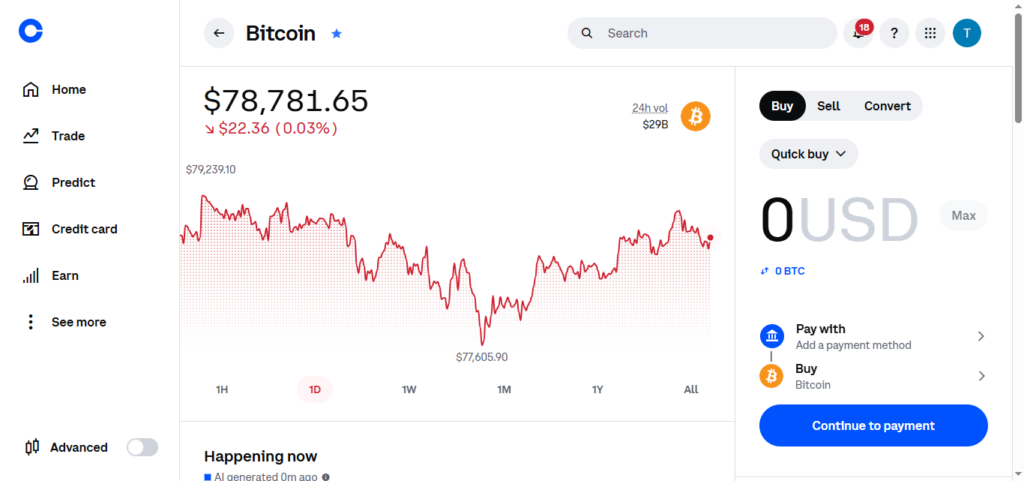
I purchased Bitcoin for the first time in May 2019 when BTC was only $8,205 and haven't had any major problems or security concerns.
Here are a chart of recommended cryptocurrency exchanges depending on your country/place of residence:
| Country | Recommended place to start | Best for |
|---|---|---|
| 🇺🇸 United States | Coinbase | Beginners |
| 🇨🇦 Canada | Kraken | Overall |
| 🇬🇧 United Kingdom | Coinbase | Beginners |
| 🇦🇺 Australia | CoinSpot | Beginners |
| 🇳🇿 New Zealand | Independent Reserve | Local users |
| 🇵🇭 Philippines | Coins.ph | PHP / local users |
| 🇩🇪 Germany | Coinbase | Beginners |
| 🇫🇷 France | Coinbase | Beginners |
| 🇳🇱 Netherlands | Bitvavo | EUR / local users |
| 🇸🇬 Singapore | Coinhako | Local users |
| 🇯🇵 Japan | bitFlyer | Local users |
| 🇧🇷 Brazil | Mercado Bitcoin | BRL / local users |
| 🇲🇽 Mexico | Bitso | MXN / local users |
| 🇿🇦 South Africa | Luno | Local users |
| 🇦🇪 UAE | BitOasis | Local users |
Can You Withdraw Your Bitcoin?
This is particularly important if you eventually want to control your Bitcoin yourself.
Some apps provide exposure to Bitcoin but don't allow you to withdraw actual BTC to an external wallet.
If your goal is to eventually practice self-custody, make sure the service you choose supports Bitcoin withdrawals to an address you control.
Don't assume every app that displays a Bitcoin price gives you the same ownership and withdrawal options.
2. Create and Verify Your Account
After choosing a platform, you'll typically create an account using your email address and personal information.
Most reputable regulated platforms require identity verification (KYC) before allowing you to buy Bitcoin. You may be asked to provide identification and other information to comply with financial regulations.
Turn on two-factor authentication (2FA) as soon as your account is created. 2FA protects your crypto account from hackers and thieves who try to access your account without your permission.
Here's a list of ways to protect your account:
- Authenticator App (Recommended)
- Security Key (Most Secure)
- Passkey (Recommended)
- Text Messages (Not Recommended)
Use one of the top 3 methods listed above but avoid using solely text messages so you don't become a victim of SIM Swap scams.
3. Deposit Money
Once your account is verified, you'll need to fund it before purchasing Bitcoin.
Depending on the platform and country, you may be able to use:
- Bank transfer
- Debit card
- Credit card
- Other supported payment methods
Bank transfers can often be less expensive than card purchases, but the available options vary by country and platform.
Before depositing a large amount, consider making a small test transaction so you can familiarize yourself with the process.
4. Buy Bitcoin
Once your account is funded, look for Bitcoin (BTC) on the platform and select the option to buy it.
You'll usually be able to enter either:
- The amount of your local currency you want to spend, or
- The amount of Bitcoin you want to purchase.
You don't need to buy 1 BTC. Bitcoin is divisible into 100 million satoshis, so you can purchase a fraction of a Bitcoin.
Before confirming the order, review the total amount you'll pay, the amount of BTC you'll receive, and any fees.
A platform might advertise a low trading fee while making money elsewhere.
Look at:
- Trading fees
- Buying and selling spreads
- Deposit fees
- Withdrawal fees
- Bitcoin network fees
- Conversion fees
- Minimum purchase amounts
A platform with a slightly higher advertised fee could potentially be cheaper overall if its spread and withdrawal costs are lower.
Then confirm the purchase.
Congratulations—you now own Bitcoin.
5. Decide Where to Keep Your Bitcoin
After buying Bitcoin, you have another important decision: where will you store it?
You can leave it on the platform where you purchased it, or transfer it to a Bitcoin wallet that you control.
For a small amount while you're learning, keeping it on a reputable platform may be convenient. For larger or long-term holdings, you may want to learn about self-custody and hardware wallets.
The important thing is not to rush this decision. Learn how Bitcoin wallets and private keys work before transferring a significant amount of money.
If you choose self-custody, losing your recovery phrase can mean permanently losing access to your Bitcoin. Never share your recovery phrase with anyone, and never enter it into a website or send it to someone who claims they need it to “verify” or “recover” your account.
You Don't Need to Time the Perfect Price
Another common beginner mistake is waiting for the “perfect” Bitcoin price.
Nobody knows exactly where the bottom or top will be in advance.
Some investors prefer to make one larger purchase, while others use dollar-cost averaging (DCA) by investing a fixed amount at regular intervals.
For example, instead of investing $1,000 all at once, someone might invest $100 every week for 10 weeks.
DCA doesn't guarantee a profit, and it won't always produce a better return than investing everything immediately. Its biggest advantage for some investors is that it removes some of the pressure of trying to predict the market.
Common Bitcoin Buying Mistakes
Buying Bitcoin is relatively simple. Making avoidable mistakes is also surprisingly easy.
Here are some of the biggest ones.
1. Buying More Than You Can Afford
Bitcoin can experience large price swings.
Don't use money you need for rent, food, debt payments, emergency expenses, or other essential obligations.
2. Trying to Predict Every Price Move
It's tempting to wait for the perfect crash or try to sell every top.
Most people aren't consistently able to predict short-term Bitcoin price movements.
Have a strategy before buying rather than making decisions based entirely on emotion.
3. Using Leverage
Borrowing money to speculate on Bitcoin can magnify both gains and losses.
Beginners should understand the risks of leverage before considering it.
You don't need leverage to own Bitcoin.
4. Keeping Large Amounts on an Exchange Without Understanding the Risks
Convenience isn't the same thing as control.
If you plan to hold a significant amount of Bitcoin for years, learn how self-custody works and decide whether it makes sense for your situation.
5. Losing Your Recovery Phrase
Self-custody comes with responsibility.
If you lose the information required to recover your wallet, you may permanently lose access to your Bitcoin.
6. Falling for Bitcoin Scams
Be extremely skeptical of anyone promising guaranteed Bitcoin returns.
Common scams include:
- Fake investment websites
- Fake customer support
- Giveaway scams
- Phishing websites
- Romance scams
- Fake Bitcoin recovery services
- People asking you to send Bitcoin in exchange for more Bitcoin
If someone promises to double your Bitcoin, walk away.
7. Sending Bitcoin to the Wrong Address
Bitcoin transactions generally cannot simply be reversed like a credit-card transaction.
Always double-check the destination address and network before sending funds.
For a large transaction, consider sending a small test amount first.
Frequently Asked Questions
Yes. Many platforms allow you to purchase a small amount of Bitcoin. You don't need thousands of dollars to get started.
Not necessarily. Many platforms provide custody when you purchase Bitcoin. However, learning how Bitcoin wallets and self-custody work is important if you plan to hold significant amounts yourself.
The Bottom Line
Buying Bitcoin for the first time doesn't have to be complicated.
Start by choosing a reputable platform available in your country. Verify your account, deposit money, purchase the amount of Bitcoin you're comfortable owning, and then learn how you want to store it.
The most important thing is not to rush.
You don't need to become a Bitcoin expert before buying $10 worth. But if you eventually build a significant Bitcoin position, you should understand how exchanges, wallets, private keys, recovery phrases, transactions, and security work.
Bitcoin gives you more control over your money—but with that control comes responsibility.
Start small. Learn the process. Protect your Bitcoin. And never invest more than you can afford to lose.
